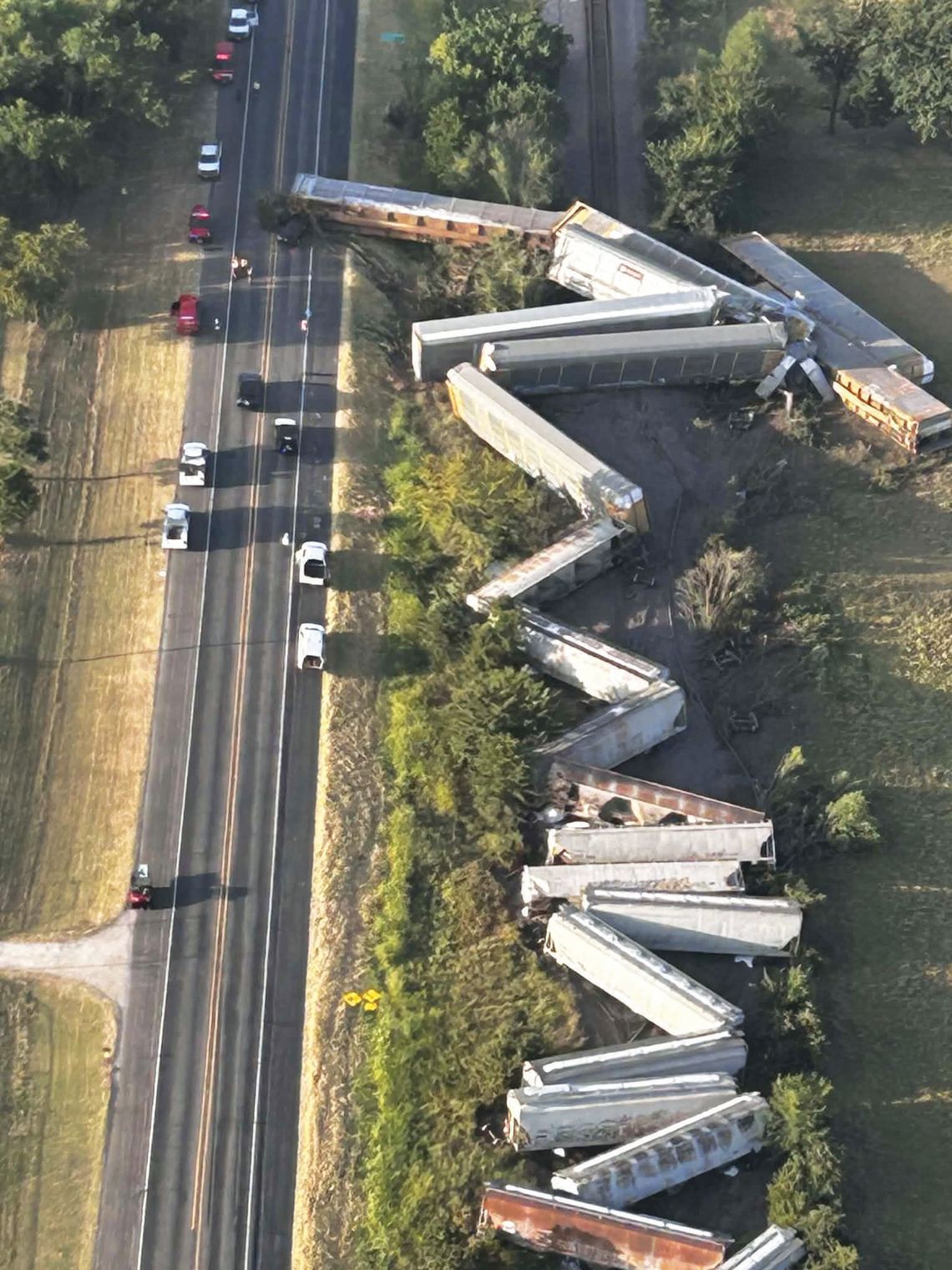
At 5:20 a.m. Sunday, Aug. 16, area first responders were dispatched to a train derailment and vehicle accident on U.S. 377 just north of County Line Church Road in Collinsville.
Collinsville Fire Chief Damon Stewart was the first to arrive on the scene. There he discovered that a train had derailed and was blocking the highway. After the derailment, a vehicle struck one of the rogue train cars. The driver of the car, a 69-year-old woman, was airlifted to Medical City Denton for trauma care and later died from her injuries.
Collinsville Fire, Whitesboro Fire and EMS, Whitesboro Police and the Grayson County Sheriff’s Office soon arrived and assisted with shutting down the highway for traffic control and rendering aid. Meanwhile Stewart assessed the train scene, which spanned more than four miles.
“It was 5:20 in the morning, so it was still dark. On top of that, there was so much dust in the air, it was difficult to really see what was going on,” Stewart said.
Stewart eventually determined that the derailment occurred around the 40th car of a 155-car train (which included four engines). The derailment caused the knuckles connecting the rail cars to break, allowing some cars farther toward the front of the train to continue down the track unaffected.
A total of 23 cars had derailed, with approximately 100 cars remaining behind them. Fourteen of the derailed cars were carrying an unknown substance, which was leaking onto the ground from 11 of those cars.
“We needed to know right away what was in those train cars,” Stewart said. “Was it hazardous material? Non-hazardous? I needed to know if I was putting our first responders in danger by simply being there and breathing in the air.”
Using the train cars’ placards and identification numbers, along with information provided by the train’s conductor and engineer (both of whom were unharmed in the incident), first responders determined the derailed cars were carrying powdered soda ash.
In its dry form, soda ash is considered non-hazardous. However, Stewart said, the material can become dangerous when water is applied. This meant firefighters were prohibited from using water at the site, which luckily wasn’t needed.
Stewart also learned that the only other potentially hazardous material being transported on the train was ethanol. Two rail cars located near the front of the train were carrying the substance, but they were not involved in the derailment and in fact continued on down the track.
Once the materials had been identified and the site was deemed safe, first responders waited for railroad officials to arrive and take over the scene. Stewart maintained command until Union Pacific officials and TxDOT personnel arrived.
Their arrival allowed some of the first responders who had been assigned to close both directions of U.S. 377 and manage traffic to be relieved from the scene.
Police and railroad officials began investigating the incident while railroad crews worked to remove the derailed cars from the railway. Crews also removed and replaced sections of track damaged in the derailment. They also began disassembling rail cars that were damaged beyond repair and would have to be scrapped.
U.S. 377 reopened around midnight, and normal train traffic resumed shortly afterward.
The cleanup, however, is expected to continue for several weeks as officials work to contain and remove material spilled during the derailment. Special equipment will be brought in to move the rail cars that remain along U.S. 377 to another location, where they can be safely disassembled and removed.
The cause of the derailment remains under investigation. Officials do know that, because of its size, the train was operating under a special permit. Special permit trains do not operate continuously and must meet specific classifications. Although such trains are permitted to travel at speeds of up to 50 mph, GPS tracking data showed this train was traveling approximately 38 mph when it derailed on a straight stretch of track.
In his 37-year career, Stewart has responded to several train derailments. The only larger incident he can recall occurred approximately 21 years ago in Collinsville, when two trains collided head-on. That incident involved explosions and hazardous materials and took approximately 48 hours to clear.
The Aug. 16 derailment, Stewart said, was a major incident.
“This is a very large-scale event,” he said. “In the last 20 years, this is probably the largest train derailment I’ve seen.”