The newspaper office is a treasure trove of history.
Each edition tells the story of its day while preserving the stories that came before it. Archives dating back to the 1800s remind us of bargain grocery prices, the founding families who shaped our communities and the everyday moments and milestone events that helped define the towns we call home.
Preserving those historic records is essential to understanding our past and documenting the people, places and events that led us to today.
Until recently, those archives were stored in bound volumes on dusty shelves, flimsy boxes and towering stacks that made them easy to reference but difficult to protect. As the News-Record prepared to move into a smaller office, one thing became clear: there had to be a better way to preserve and protect these documents.
The books and boxes occupied valuable space, but more importantly, they were vulnerable.
Decades-old pages had become brittle. A leaky roof had caused water damage, a long-ago fire destroyed several editions and even termites had claimed their share of history. Preservation had become a necessity.
That search for a better solution led the newspaper to Ana Krahmer, director of the Digital Newspaper Program at the University of North Texas (UNT) Libraries. Krahmer oversees the Texas Digital Newspaper Program, the nation’s largest single-state, open-access newspaper preservation repository.
“Texas has a huge publishing industry,” Krahmer said. “Our goal is to preserve every newspaper in Texas from every community. That includes high schools, colleges and community interest publications.”
UNT hosts the Portal to Texas History, an internationally recognized digital preservation platform that provides free public access to millions of historical Texas documents. Established in 1999, the portal has grown through support from the National Endowment for the Humanities, the Texas State Library and Archives Commission and numerous other grants and partnerships.
“It became such a huge endeavor,” Krahmer said. “Everyone in Texas wanted to contribute, and it represents a collaborative effort across the state, not just UNT. We provide the technology, scanning and digital preservation, but the communities are the ones who have been preserving these materials all along.”
The digitization program is available to anyone with Texas history materials. After scanning, all original items are returned to their owners along with digital copies. Because UNT does not claim ownership of the digitized files, organizations are free to use them on their own websites as well.
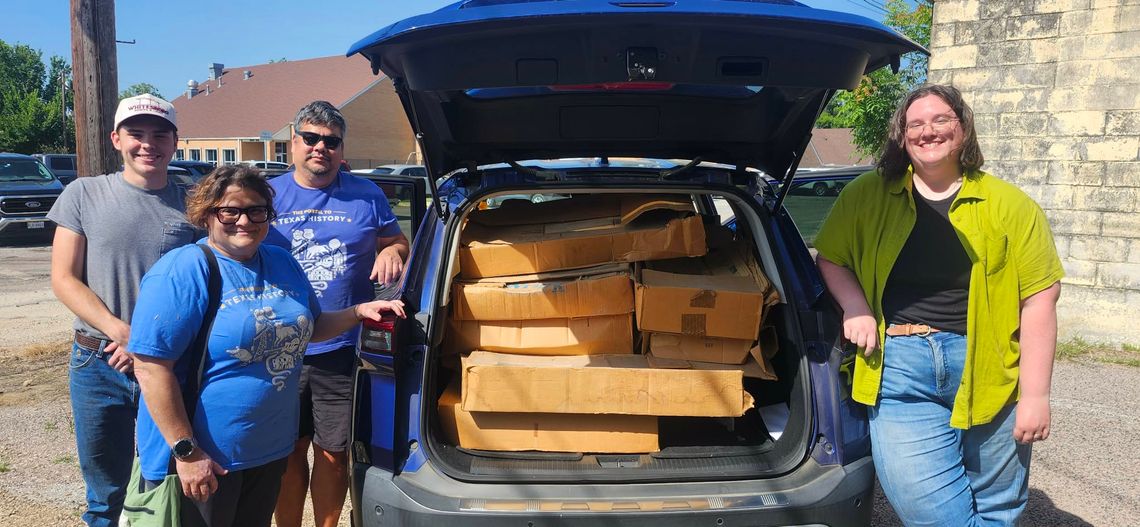
The process begins with a detailed inventory. For the News-Record, that meant gathering dozens of boxes of historic newspapers and transporting them to the UNT campus. Once the inventory is complete, the team pursues grant funding through organizations such as the Tocker Foundation, which helps communities with populations under 12,000 digitize their newspapers.
“We are thrilled to partner with UNT on this project and appreciate Dr. Krahmer, and her team, for taking interest in our history,” News-Record publisher Austin Lewter said. “Having these archives saved for generations to come is exciting.”
While funding is being secured, preservation work begins immediately. Newspapers are carefully placed in archival boxes, bound volumes are disassembled and pages are transferred into acid-free storage, ensuring they are protected and ready for scanning.
The News-Record’s project is expected to take approximately one year.
It takes an entire team to complete projects of this scale. Krahmer oversees the program while also handling microfilm scanning. Three full-time staff members specialize in physical preservation, metadata creation and optical character recognition, allowing every page to become fully searchable online.
The department also employs 15 to 20 student workers each year—many studying history, library science or journalism—who assist with everything from inventorying collections to operating large-format scanners.
Krahmer never planned to become a preservation specialist.
After earning her master’s degree, she managed information technology (IT) programs at Texas Tech University before joining its Special Collections Library. When the opportunity at UNT arose in 2011, she immediately recognized its potential.
“I was just so impressed with what it could become,” she said. “There was nobody else in the state doing something as interesting and exciting as this.”
Her background in technology management, grant writing and technical communication proved to be a perfect fit.
When Krahmer joined the program, the archive contained approximately 250,000 digitized historic pages. Today, that number has grown to more than 13.1 million.
Despite the remarkable growth, Krahmer says her favorite part of the job isn’t the technology—it’s the people.
“Texas has a huge, long publishing history—even before it was Texas,” she said. “It’s really special to meet the people who have spent years saving these newspapers. Being able to return and say, ‘Your newspapers are preserved, they’re searchable and they’re protected for future generations,’ is incredibly rewarding.”
Today, the Portal to Texas History partners with museums, public libraries, universities, schools, historical societies and commissions across the state. In addition to newspapers, the portal preserves photographs, maps, manuscripts and countless other documents that tell Texas’ story.
“We just host the technology,” Krahmer said. “The communities are the ones building these collections and making them meaningful. That’s really the power of the portal.”
The program’s scope is virtually unmatched.
“The work we’re doing is more comparable to national libraries in Europe than to programs in other states,” Krahmer said. “Texas is really special in that way.”
Krahmer is quick to credit the organizations and partners who make the program possible.
She praised Mike Hodges and the Texas Press Association for their long-time partnership and support in preserving Texas newspapers. Additional funding comes through the Institute of Museum and Library Services, administered by the Texas State Library and Archives Commission through its competitive TexTreasures grant program.
The Tocker Foundation provides funding for newspaper digitization projects in Texas communities with populations under 12,000 and county libraries. The Ladd & Katherine Hancher Foundation supports communities with populations under 50,000, while the National Endowment for the Humanities funds preservation efforts through the National Digital Newspaper Program.
Together, those partnerships have helped build one of the most comprehensive digital newspaper archives in the nation.
For the News-Record, the project means far more than preserving old newspapers. It ensures that 150 years of local history—from births and weddings to elections, businesses, schools and everyday life—will remain accessible to future generations. Long after the ink has faded and the paper has grown brittle, the stories of our community will continue to live on.
Texas has always been passionate about preserving its history, and the Digital Newspaper Program at UNT Libraries ensures those stories will remain accessible for generations to come.
Located on the third floor of UNT’s Willis Library, Krahmer and her team welcome visitors interested in learning more about the digitization process. For information about preserving Texas history collections, contact Ana Krahmer at [email protected] or 940-565-3367, or Jake Mangum at [email protected] or 940-565-3023.
From Print to Pixels: UNT’s Digital Newspaper Program preserves the past for future generations
08/07/2026 06:00 AM