
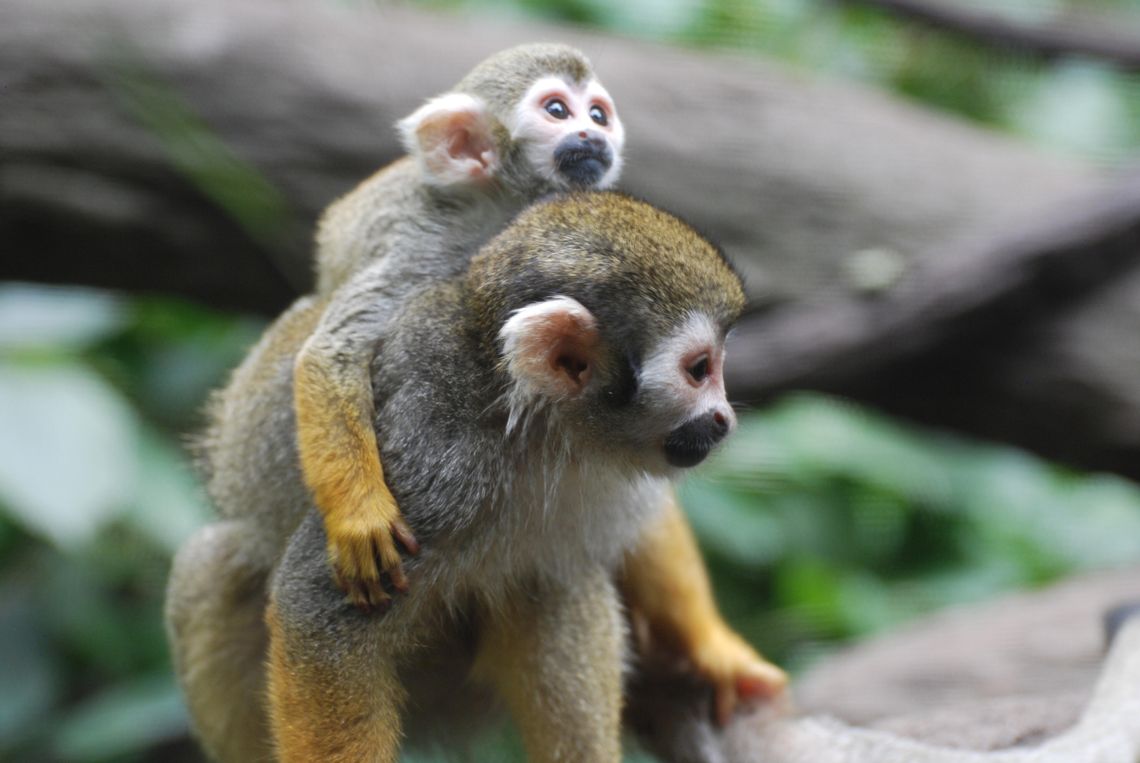
Primates are considered to be among the most intelligent creatures in the animal kingdom. This is especially true for chimpanzees, who top the list of non-human intelligence. However, among primates, it is not just chimps who possess high intelligence; various species of monkeys show incredible intellectual abilities, including the ability to analyze and influence their environment and fellow primates.
Studies show that primates utilize a unique language of facial expressions, gestures and various screams, hoots, grunts, roars and howls to communicate, interpret and process information. Howler monkeys, for example, derive their name from their use of loud howls to communicate. For long-distance communication, all primates naturally make louder sounds, such as hand drumming on tree trunks, and quieter sounds for close interactions.
Interestingly, their high intelligence allows them to judge whether or not their intended message has been understood.
If they suspect their intent has not been understood, they are known to change their sounds and gestures depending on the response they receive. They have also been observed to repeat a particular communication sequence if they suppose the recipient is not paying attention.
Primates are also masters of tool use. These tools include using grass stalks, vines and stripped branches to fish for termites. First, however, chimps use a sturdier stick as a spade to break through the tough outer surface of the mound, then, switching tools, they insert the thinner probe into the uncovered holes, fishing the termites out, which they eat directly off the probe.
Primates are also observed using stones as hammers to open nut shells, moss as sponges to absorb water for drinking and tree branches and long sticks to cautiously probe unknown objects. No doubt, the great primates display a high level of intelligence through their ability to learn, communicate and use tools.
However, their intellectual attributes go even further.
Primates recognize themselves and others as individuals, even mourning the death of others, exhibiting a period of depression as part of a conscious mourning process. They also acknowledge a particular moral code within the troupe, which, when violated, can lead to the perpetrator being ostracized for breaking an established social ethic.
Quite simply, primates can feel deeply and can suffer. Most importantly, however, primates seem to have the capacity to recognize that they exist as individuals and can reflect on their existence as distinct from others’.
Because of this, among other things, primates are considered sentient creatures, and that’s a pretty big deal.
It is argued that, like human beings, who are unilaterally protected under the Universal Declaration of Human Rights, sentient animals should be afforded such rights, with some arguing for the granting of “personhood” to primates, based in part on their intellectual capacity and sentience.
The intent of their work is certainly noble—animal cruelty of any degree should never be tolerated.
I say all this to say I recently had the great opportunity to observe several monkeys—Howlers in particular—in their natural habitat in Northern Costa Rica. It was a lifetime opportunity, and the experience was both splendid and breathtaking. Nevertheless, the thought persisted that primates share approximately 98 percent of the same DNA as humans.
The evolutionist, of course, argues that this should come as no surprise since human beings and primates share a common ancestor. After all, it’s obvious that primates are brilliant creatures, right? Common DNA is presented as concrete evidence of our evolutionary progress from a slimy warm pond, through the primate stage, to modern human beings.
All told, it is not hard to see where the “missing link” theory came from—that thought that a direct link can be established from, say, our last common ancestor, to human beings, except for a missing link occurring between primates and the first human beings.
But I am not so sure this is correct. Rather, I suspect it’s not true at all. It is well known in the field of genetics that human beings share 98 percent of the same DNA as pigs! (Humans also share 85 percent of the same DNA with mice, so go figure.) After all, with only four nucleotides (adenine, guanine, cytosine, and thymine) naturally available to make up the DNA of all species, there has to be some significant overlap. More than that, it is incredibly misleading to suggest that the high intelligence in primates provides solid evidence of their close evolutionary relationship to humans.
Intelligence is highly contextual and subjective. Yes, primates (IQ~25) are extremely intelligent compared to, say, earthworms (IQ of say, ~0.05), but not so much compared with human beings (IQ~110).
This became abundantly clear during my trip home from South America. Flying aboard a Boeing 737, cruising at 35 thousand feet and 580 miles per hour, guided by GPS data provided through a satellite orbiting the earth, sipping an iced Coca-Cola® over ice all the while reflecting upon Howler monkeys setting in the trees of the Costa Rican rain forest, naked, homeless, grunting and hooting at one another over whose turn it is to stick their stalk of grass into a termite nest to fish out a meager lunch—contemplating all of that, reality became crystal clear.
Rather than a metaphorical missing evolutionary link between primates and human beings, there must surely be very many missing links.
Christians hold that human beings alone to be uniquely created in the image of God. Everything else is something lower in the created order, and that is indeed what we see in the world. By the way, the people with the highest IQs?
The Ashkenazi Jews of the Rhineland Valley. Smartest people in the world—God’s people. Now isn’t that interesting.
Gloria in excelsis Deo!
Ty B. Kerley, DMin., is an ordained minister who teaches Christian apologetics and relief preaches in Southern Oklahoma. Dr. Kerley and his wife, Vicki, are members of the Waurika church of Christ and live in Ardmore, OK. You can contact him at [email protected].