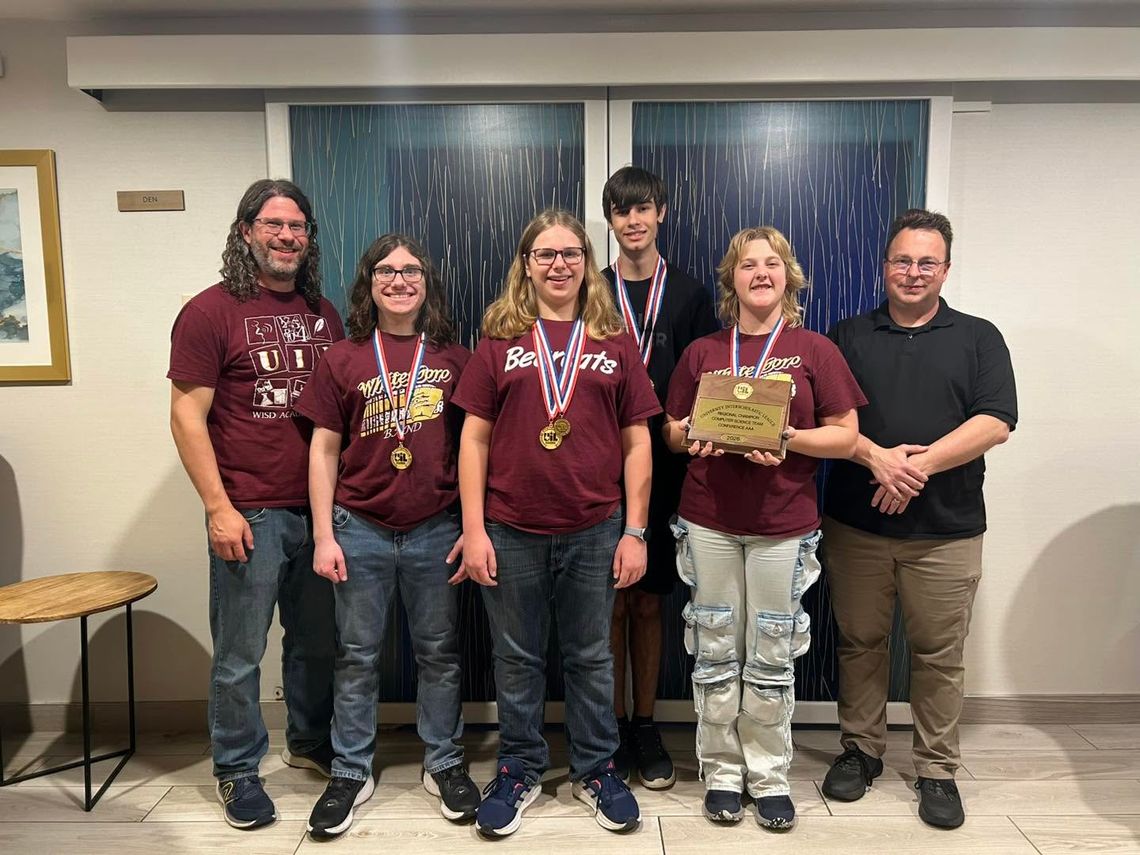
For a group of Whitesboro High School (WHS) students, months of preparation, problem-solving and perseverance culminated on the biggest academic stage in Texas.
The Whitesboro UIL Computer Science team — senior Siena Bensley, juniors Jeremy Krause and Jake Niles and freshman Ian Niles — advanced to the UIL Academic State Meet after winning the regional championship. Meanwhile, sophomore Layla Carey earned a trip to State in feature writing after placing third at Regionals.
The team’s fifth-place finish at State and Carey’s strong showing in feature writing reflected months of preparation, growth and determination.
For the computer science team, the season represented self-teaching and determination.
“This year was kind of our first year actually getting like a real team together and doing stuff, because we don’t have any computer science classes at our school,” Bensley said.
Without formal classes available, much of the team’s early development came through independent learning. This year, however, they received additional guidance from family members with professional experience in the field.
“Jake and Ian and my fathers are actually software engineers,” Bensley said. “So they came in and they were helping work through with us and actually came and helped teach us some stuff.”
The extra support helped the team build a stronger foundation, but there was still plenty to learn.
“A lot of the year we spent learning how to teach this stuff,” Bensley said. “Learning what exactly the tests are.”
The computer science competition consists of two parts: an individual written exam and a team programming contest in which competitors program solutions to a set of coding problems under a time limit.
The Whitesboro team quickly discovered its strength was programming.
“Most teams are pretty weak with the programming part just in general,” Bensley said. “But our team is pretty strong with the programming because we focused on that a lot.”
That focus paid off throughout the season.
The team narrowly missed advancing to State the previous year, making this season’s Regional championship especially meaningful.
“Last year we got second, and we really should have won that,” Krause said. “It was a very slight minor error.”
Even at Regionals this year, the team faced uncertainty after discovering one of their problems had not been graded correctly.
“I was personally at least really worried that we weren’t going to make it,” Krause said. “But somehow we still did, luckily.”
The announcement that they were advancing to State brought relief and excitement.
“That was just such a good feeling, because we just locked it in that we were all making it,” Krause said.
While the team members approached State with different emotions, they all shared excitement about the opportunity.
“I came into day one feeling very confident,” Krause said. “Because confidence matters, I think. I think if you’re confident, there’s a better chance you do good.”
That confidence was tested quickly.
State competition took place over two days, with the written exam on the first day and programming competition on the second.
“I tried my hardest, and then I kind of failed miserably,” Krause said with a laugh. “And then I was like, ‘Alright, we’ve got to lock in on day two.’”
When day two arrived, competitors found themselves facing one of the toughest programming contests they had encountered all season.
“The test was really hard, much harder than I expected it ever even could be,” Krause said.
Jake Niles focused less on the pressure of the results and more on appreciating the experience.
“For the most part, I wasn’t really nervous,” he said. “I was kind of just glad to be there.”
Jake said competing itself was rewarding.
“I just like doing it,” he said. “It’s unfortunate that we didn’t do as well as we probably could have, but I’m just glad that we went.”
Ian competed in the written portion and joked about relying on his teammates to handle the programming side.
“I only do the written test, not the programming part,” he said. “So it’s just these guys that have to carry us to victory.”
His teammates quickly pointed out that Ian’s performance was critical to the team’s success.
“Ian’s written score test made up almost half of the points for the written test,” Jake said.
Without his contribution, the team’s Regional championship run may not have happened.
The season also produced several memorable moments along the way.
One of Krause’s favorite memories came at the Regional meet, where he exceeded his own expectations on the written exam.
“Normally during the written test, I’ll get about top 10, but not the top five usually,” Krause said. “But I did really good in the region and actually got first place on the written test.”
The result gave him a confidence boost before team scores were even announced.
“It just felt really good to just get there right at the start, knowing that I was going to advance no matter what happened,” Krause said.
Beyond the scores and rankings, the students said the season taught them valuable lessons about collaboration.
“Figuring out not just how to do the programs, but how to actually work together time-efficiently and as a team,” Bensley said, “not just during tests, but also during the practices and figuring out how to do all that together was definitely a learning experience.”
With Bensley graduating, the remaining three team members are already looking ahead.
“I feel like we can get there and perform to the level that we want to,” Jake said.
The team hopes the experience gained this year will help them take another step forward next season.
“We had a lot of fun,” Bensley said. “10 out of 10, would do it again.”
While the computer science team tackled algorithms and programming challenges, Carey spent her season honing a very different skill set.
UIL feature writing gives competitors a fake scenario and tasks them with extracting information and crafting compelling stories under a strict time limit.
Carey first competed in the event last year but did not advance beyond District.
This season, she made a significant jump.
“I feel like I’ve grown a lot,” Carey said. “It doesn’t always feel like that — I feel like sometimes I just do the same thing — but I truly have grown quite a lot from when I first started.”
Much of her preparation came from studying previous contests and learning from successful examples.
“I used Pocket Coach Academy,” Carey said. “It’s like this UIL website that has lesson plans.”
The resources gave her access to previous State-winning stories and competition materials.
“Just going through those sample stories that it gave me from years prior really helped because it showed me what the UIL creators wanted from me,” she said.
After placing third at district and third again at Regionals, Carey earned a coveted State berth.
“It was definitely surprising because I wasn’t very confident in my abilities,” she said. “But it was super exciting to know that I got to go to State for feature writing, and I felt super cool.”
Unlike some competitors who feel nervous for days before competition, Carey said her anxiety did not hit until moments before the contest began.
“I woke up being totally fine,” she said. “I’m like, ‘Whatever, I’ve got to go do this competition.’ It wasn’t until I was in the room with my printer and my computer set up that I was like, ‘Oh crap, I’m about to have to do this,’” Carey said.
After settling into the contest, however, she found her rhythm.
“Everything went smoothly, I feel like,” she said. “I wrote my story, did everything fine.”
Carey ultimately tied for seventh place at State, outside the top six medal positions. Carey viewed the experience as motivation.
“My hope is that I’m going to keep doing it and keep advancing well,” she said. “Hopefully I’ll make it to State my junior and senior year.”
Her long-term goal is clear.
“I really hope that if not next year, then definitely senior year, I’ll place top six,” Carey said.
What keeps her returning to feature writing is the opportunity to be expressive.
“I like feature writing a lot because I like to be entertaining and to be creative and witty,” she said.
For Carey, crafting an engaging opening is one of the most enjoyable parts of the process.
“The most important part of any feature writing is the intro, the hook,” she said. “So that’s my favorite part of feature, is getting to be witty and make puns and say some funny lines.”
Like the computer science team, Carey said the benefits of UIL extend beyond competition.
“Definitely doing UIL helps in so many areas and not just school related,” she said.
The skills she has developed through feature writing have carried into other parts of her life.
“It’s helped me be a better communicator,” Carey said. “It’s helped me be a better leader and to get information more concisely and to just let my creative juices flow.”
Whether they were writing stories or writing code, Whitesboro’s State qualifiers spent this year proving what can happen when preparation meets opportunity. For many of them, next year’s goals are already taking shape.